Intent-Driven Development
Jul 03, 2026 • 15 min read
Intent-Driven Development: What Happens When Your Prototype Becomes the Requirement
How AI changes the requirements phase of software delivery, and what your team does instead.
Every founder has felt the pull by now. AI coding tools can turn an idea into a working product over a weekend. No specifications, no meetings, no waiting on a development team. You describe what you want and watch it appear on screen. The urge to vibe-code your way straight to launch is real, and the demos are convincing.
Experienced entrepreneurs also know what happens after the demo. Real users find the gaps. Real data breaks the assumptions. The weekend build that impressed everyone starts failing in ways nobody anticipated, and fixing it costs more than building it properly would have. Proper engineering is what keeps a product standing once customers arrive, and no amount of prompting replaces it.
So the interesting question is not whether AI can build software. It can. The question is how to keep the speed of vibe-coding without giving up the discipline that production software demands. Intent-Driven Development, or IDD, is our answer. It uses AI to remove the slowest and most error-prone phase of software delivery, requirements analysis, while keeping engineering rigor exactly where it belongs.
The problem IDD solves
Traditional delivery suffers from a translation gap. Stakeholders describe behavior in documents. Analysts interpret and restructure those documents. Developers interpret them again. Every hand-off is a translation, and every translation loses intent. The result is familiar: the team builds something close to what was asked but not quite it, the stakeholder pushes back, and everyone spends a sprint arguing about what the original request meant. The cost shows up in time, in trust, and in risk that stays hidden until late.
A written requirement describes behavior. A working prototype is the behavior. There is no ambiguity about what a running system does when you click the button. IDD is built on that single observation.
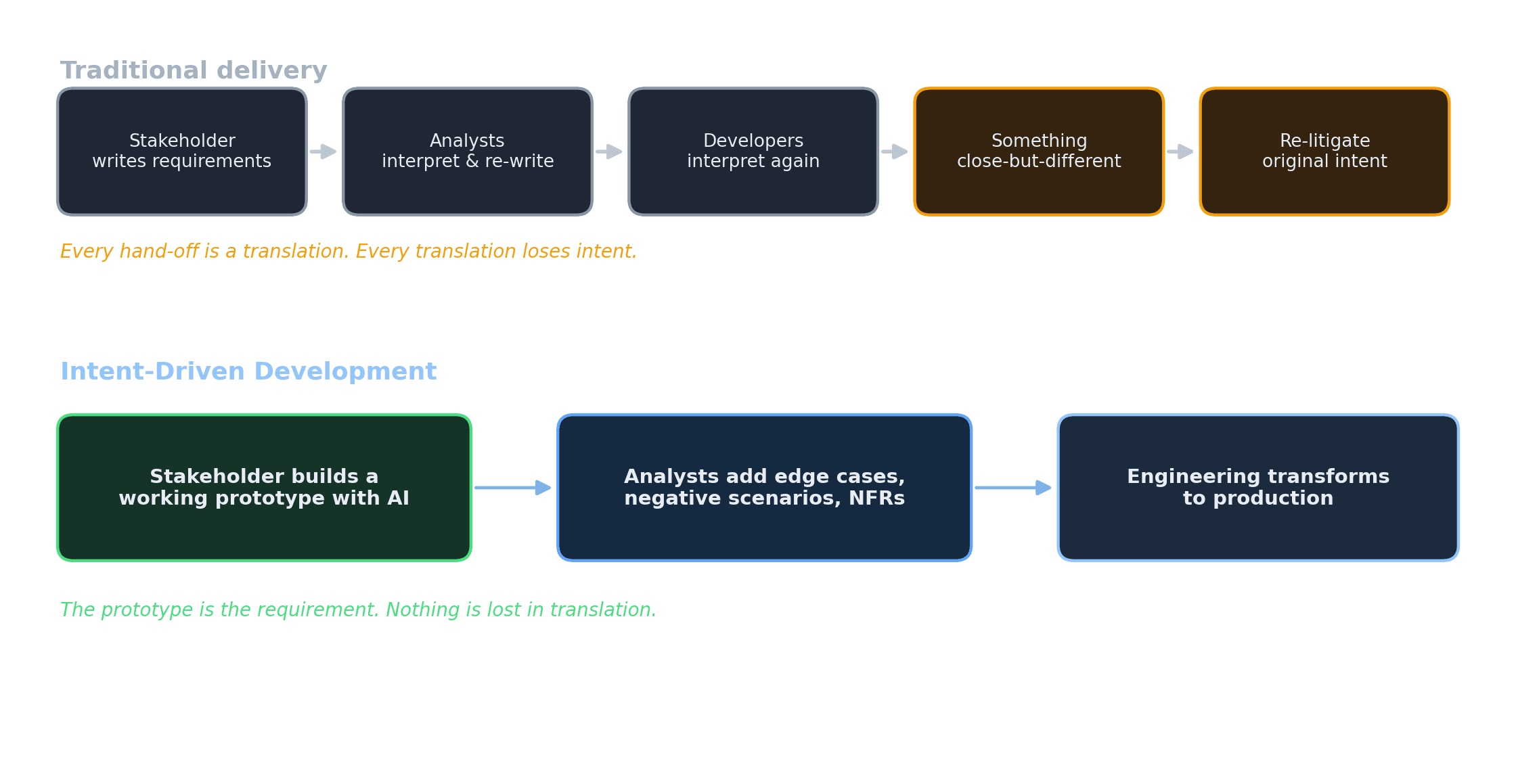
Figure 1. Traditional delivery translates intent through multiple hand-offs. IDD makes the stakeholder a producer of behavior instead of a describer of it.
The prototype is the requirement
In IDD, the stakeholder, whether a founder, a product owner, or a subject-matter expert, works directly with an AI coding agent to build a functional prototype of the feature they want. The prototype captures executable intent: user journeys, business rules, decision logic, and screen behavior, expressed as running software rather than prose.
This does not eliminate the analytical team. It changes their job. Instead of authoring requirements from scratch, the slowest activity in the whole delivery chain, analysts complement the prototype with the things a prototype cannot show:
- Edge cases. What happens when the input is malformed, the network fails, or two users act at once.
- Negative scenarios. What the system must refuse to do, and how it should fail without damage.
- Non-functional requirements. Performance, security, scalability, auditability, and the other qualities that make software production-grade.
The analytical conversation shifts from “tell me what you want” to “your prototype does X, so what should it do when Y?” That conversation is far more productive because it starts from something concrete. Most of the specification already exists; it runs in a browser.
The skill: an analyst in the room, at all times
What separates IDD from a founder alone with a coding assistant is the skill. The analyst team prepares a pre-programmed skill: a structured set of instructions, guardrails, and behaviors that the AI agent follows throughout every prototyping session.
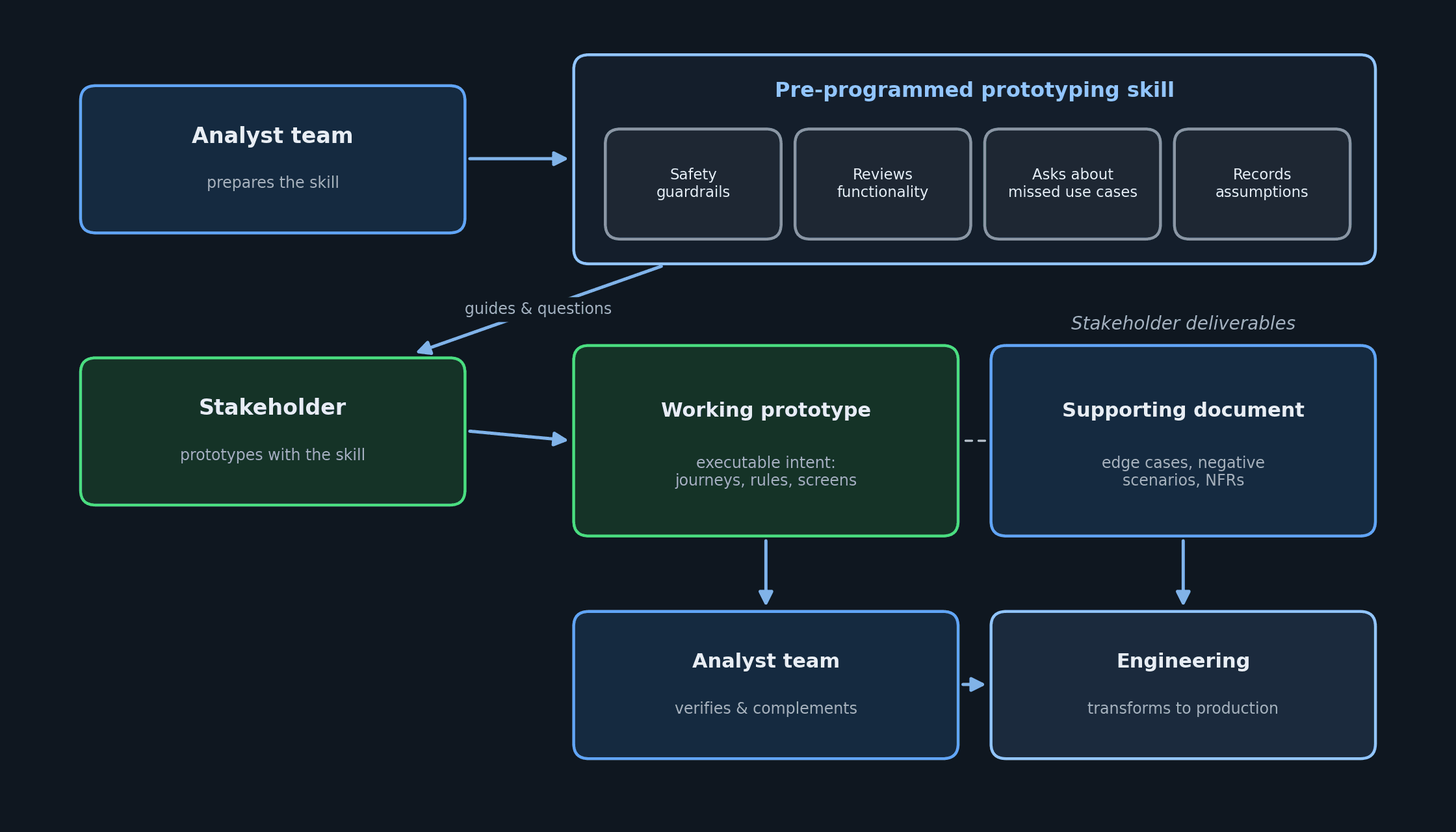
Figure 2. Analysts encode their expertise into the skill once; the skill then assists every stakeholder prototyping session.
The skill does several jobs at once. It carries safety guardrails. The agent will not let a prototype bypass authentication in a way that could be mistaken for final behavior, write to protected data, or introduce architecture the platform cannot support. When the stakeholder asks for something risky, the agent builds a safe version instead and records the decision for engineering to review. The idea is never blocked; the risky shortcut is.
The skill also thinks like an analyst. As the stakeholder builds, the agent reviews the functionality and asks the questions a good analyst would ask. What happens if this list is empty? Should this action be reversible? Who is allowed to see this screen? Can two people approve the same request? Every session becomes a structured requirements interview that happens in real time, against working software, with the answers landing directly in the prototype or its documentation.
The analyst team’s expertise is encoded into the skill once, then applied consistently in every session, with every stakeholder, at any hour. And the skill keeps improving: every completed delivery cycle ends with a short retrospective, and the lessons become updates to the guardrails.
What the stakeholder actually delivers
At the end of the prototyping phase, the stakeholder hands over two artifacts:
- The working prototype. A functional demonstration of the intended behavior: journeys, rules, and screens you can click through.
- The supporting document. A concise, co-authored record of everything the prototype cannot show: edge cases, negative scenarios, non-functional requirements, assumptions, and anything mocked or simulated.
Together these two artifacts are the specification. The supporting document is not written after the fact. It accumulates during prototyping, seeded by the skill’s questions and refined with the analyst team. By the time engineering sees the work, the most expensive questions have already been asked and answered.
How the full cycle runs
IDD has three phases and two quality gates. The rule that keeps everyone honest: each gate is owned by the party opposite the one that just worked.
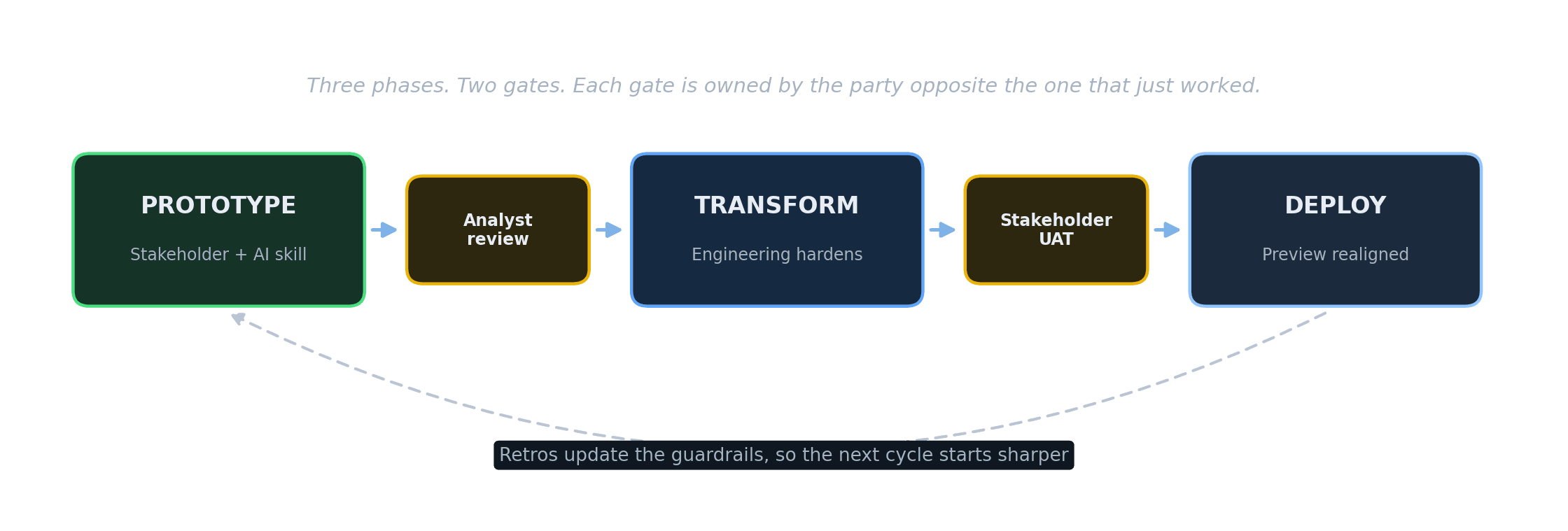
Figure 3. The IDD lifecycle: Prototype, review, Transform, UAT, Deploy, with every cycle sharpening the guardrails.
During Prototype, the stakeholder builds with the skill-equipped agent in an isolated preview environment. The analyst and engineering teams join during this phase rather than after it, reviewing iteratively, probing assumptions, and helping the supporting document take shape. The phase ends with an explicit accept, defer, or reject decision.
During Transform, engineering reshapes the prototype into production architecture and hardens it: security, performance, reliability, error handling, observability. They are not interpreting a document. They are preserving behavior that already exists and has already been validated. The prototype anchors acceptance testing.
At UAT, the stakeholder answers one question: does the production version still match the intent captured in the prototype and the supporting document? After sign-off the feature ships, the preview environment is refreshed to match production, and the next prototype starts from real constraints instead of yesterday’s mocks.
What this means for your business
The practical effects are concrete. Requirements stop being a phase and become a by-product of building. Weeks of writing, reviewing, and reconciling documents collapse into days of guided prototyping. Misunderstandings surface in hours, while the stakeholder is still in the room, instead of at the end of a delivery cycle. Scope becomes visible early: the skill flags architecturally expensive requests the moment they appear, so you learn that a feature will take four times the effort before you commit to it, not after.
One thing IDD does not promise: a prototype is evidence of desired behavior, not evidence of production readiness. Authentication, data integrity, compliance, and performance under load still require real engineering, and production delivery still takes a multiple of prototype time. What IDD removes is the waste: the translation losses, the arguments over intent, the features that reach engineering with hidden scope. What remains is work that was always necessary, now aimed at a target everyone has already seen working.
The teams that get the most out of AI are not the ones that hand developers a coding assistant and stop there. They redesign the process around what AI makes newly possible. Letting the people who understand the business express that understanding directly, with expert guardrails and inside an established methodology, is that redesign. So keep the urge to vibe-code. It is pointing you at something real. Then put a process around it that your engineers, your investors, and your customers can trust.